Unlike many skilled trades, Ontario does not require a provincial licence to operate a residential tree service. Because of that, homeowners should verify an arborist's qualifications instead of relying on advertising alone. One of the best ways to do that is by checking for current ISA (International Society of Arboriculture) certification, along with proper insurance and WSIB coverage.
Ontario recognizes an Arborist as a skilled trade that can be obtained through apprenticeship and provincial certification. However, holding that trade qualification is not a legal requirement for operating a residential tree service business.
That means the person quoting you $800 to prune your maple could be an ISA Certified Arborist with years of training in tree biology, pruning standards, and safety - or someone with limited formal training and a newly purchased chainsaw. The difference is not always obvious from the driveway.
And unlike a poor landscaping job that looks wrong immediately, mistakes in tree work often reveal themselves slowly. A poor pruning decision may take years to show its effects as the tree becomes stressed, develops decay, or requires corrective work. By the time the damage is obvious, the original contractor may be long gone, and the options for saving the tree may be limited.
That is why professional credentials matter. ISA (International Society of Arboriculture) certification is one of the strongest indicators that an arborist has met recognized industry standards, maintained ongoing education, and committed to professional practices. It should be considered alongside proper insurance, WSIB coverage, experience, and a clear written quote.
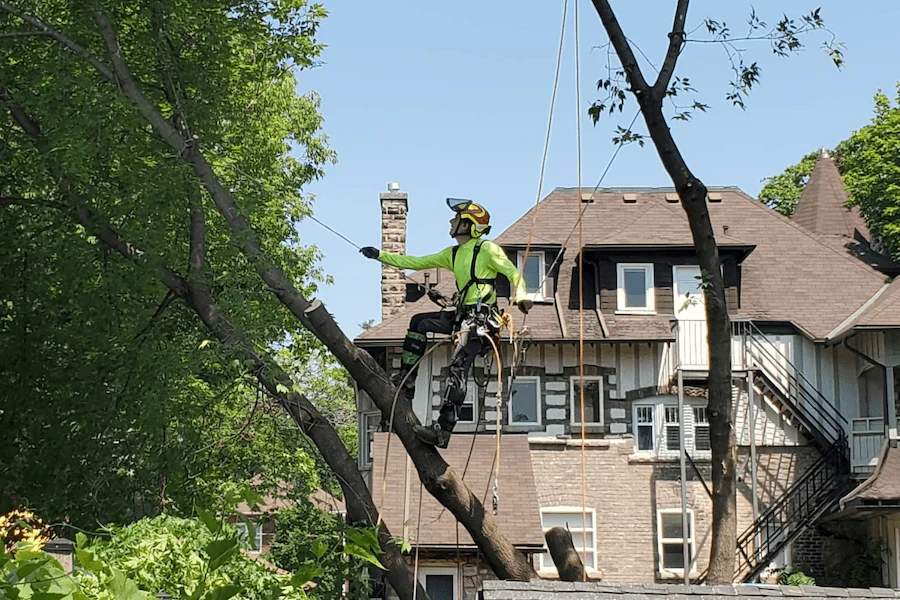
No time? The three-check minimum. If a storm just took a branch down and you need someone today, do at least this:
- Ask for the arborist's name and look them up at treesaregood.org - free, takes two minutes.
- Ask for proof of insurance and WSIB coverage before anyone climbs anything.
- If they say "topping" or plan to climb your tree with spikes to prune it - Just Say No.
These are common warning signs that the work may not follow accepted arboricultural best practices.
What "certified arborist" actually means
The credential most homeowners should look for is ISA (International Society of Arboriculture) Certified Arborist certification. It is the most widely recognized voluntary professional credential in the industry and demonstrates that an arborist has met experience requirements, passed a comprehensive examination, and maintains ongoing professional education.
For paperwork-heavy jobs - arborist reports for permits, appraisals, disputes - there's also ASCA (American Society of Consulting Arborists). That's the consulting tier, the credential municipalities and insurers take seriously in writing.
Professional certification is one of the strongest indicators of training and commitment to industry standards, but it should be considered alongside insurance, WSIB coverage, experience, references, and written estimates.
Worth being blunt about what certification is not: a business licence, a WHMIS card, or "twenty years in the industry." Experience counts, but we've also met people with twenty years of experience doing it wrong, confidently. Tree work looks simple from the ground. That's the trap.
Local Municipal Licensing
Some municipalities have additional local licensing requirements. For example, Oakville requires arborists and arboriculture companies operating within the town to obtain a municipal business licence and meet specific by-law requirements. Local requirements like these do not replace the importance of verifying professional credentials such as ISA certification, insurance, and WSIB coverage.
What the wrong crew actually costs you
The cheap quote is cheap somewhere, and there are three places the difference tends to come out.
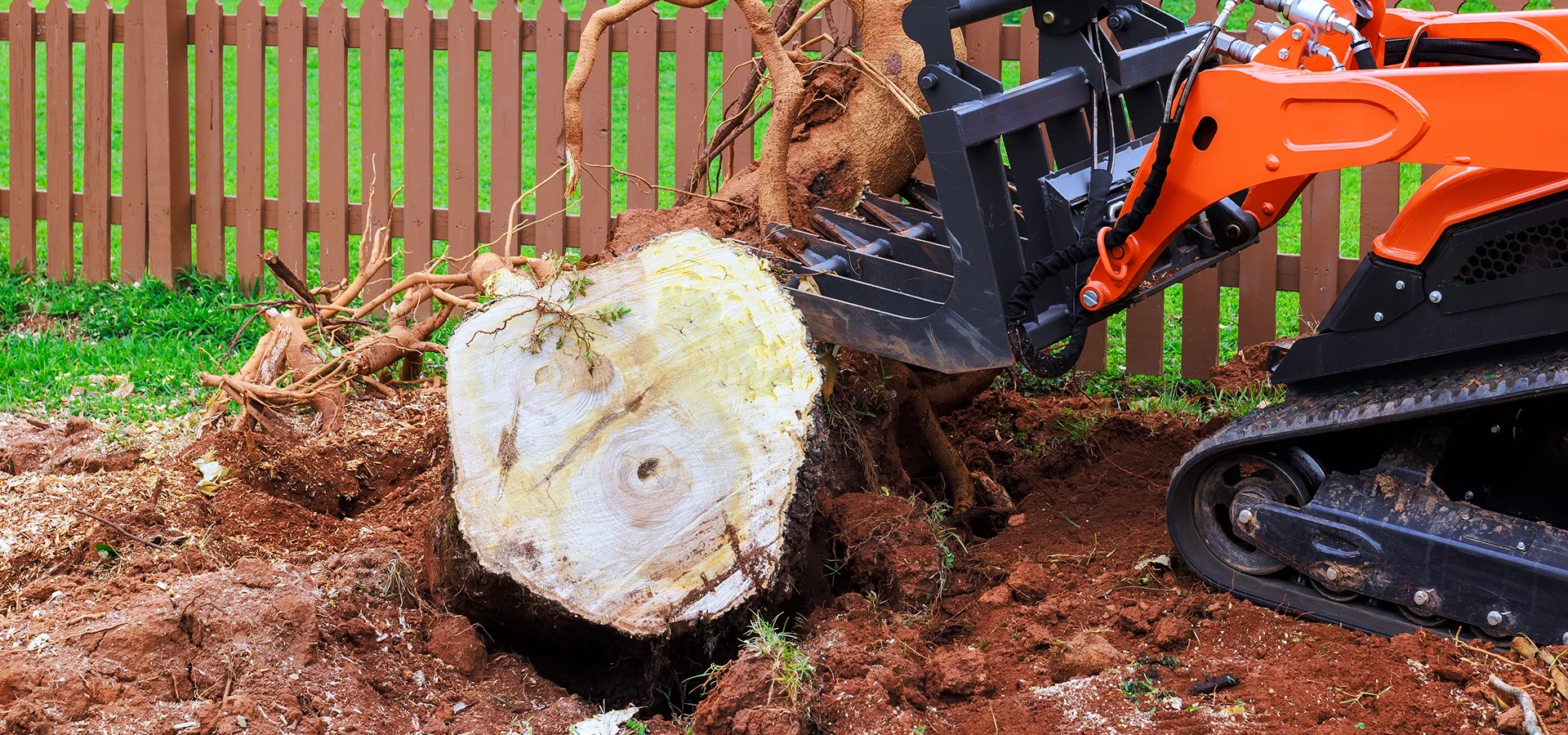
The tree pays first. The signature move of an untrained crew is "topping" - shearing the crown off a mature tree because it's fast and the customer can see something dramatic happened. Topping doesn't make a tree safer. It panics the tree into throwing up weakly attached shoots, opens every cut to decay, and typically starts the decline that ends in a removal quote a few years later. Same goes for climbing spikes on a tree that's being pruned, not removed - every spike hole is a wound. There's an actual pruning standard (ANSI A300) and certified arborists cut to it.
Then your wallet. Toronto's private tree bylaw protects trees 30 cm across and up - on your own property, yes. Remove or injure one without a permit, and the fines run into the tens of thousands, per tree. Property owners remain responsible for complying with Toronto's tree protection by-laws, even when a contractor performs work.
First: where do you even find an arborist?
Three places, in order of usefulness. The ISA's own directory at treesaregood.org lists certified arborists by postal code - everyone on it is verified by definition, which saves you a step. Google Maps works too ("arborist near me"), as long as you treat it as a longlist, not a recommendation. And neighbours who've had tree work done are underrated - in older Toronto neighbourhoods with mature canopies, someone on your street has been through this and remembers who showed up on time.
Get two or three quotes for anything bigger than a small prune. Not five - quotes take time to arrange and tree work prices honestly don't vary as wildly as, say, renovation quotes. Two or three is enough to spot the outlier, in either direction. The suspiciously cheap one is a bigger warning than the expensive one.
The 7-point vetting checklist
A legitimate company passes all seven without flinching. Honestly, the good ones enjoy being asked - it's the one moment the training gets to show before the work does.
- Verify the certification yourself. Not the badge on the website - the actual credential. The ISA runs a public lookup at treesaregood.org: search by name or cert number. Two minutes. If a company "has certified arborists" but can't give you a name and number to check, you've learned what you needed to.
- Ask for insurance proof, with numbers. Two documents: a certificate of liability insurance - $2 million is the floor for tree work, established outfits carry more - and a WSIB clearance certificate (that's Ontario's workplace injury coverage; it means an injured worker's claim goes to WSIB, not to you). Any properly run company can email both the same day. Don't want to take a PDF's word for it? WSIB clearances can be checked online at wsib.ca - search "clearance eService," type in the company name. Vagueness here isn't a negotiating position, it's your exit.
- Written, itemized quote. Always. "Crown clean, deadwood over 5 cm, raise canopy to 4 m over the driveway" is a quote. "We'll tidy it up, twelve hundred cash" is a story you'll be telling your insurance adjuster.
- Recent local reviews, and a reference if you want one. Skip the testimonial page on their own site; read Google reviews sorted by newest. You're looking for years of consistency, not five glowing reviews posted the same week. Anyone proud of their work has a customer nearby who'll say so.
- Ask them how - then listen for two words. This is the impostor detector, and it works embarrassingly well. Ask what they'd actually do to your tree. If the answer includes topping, or they plan to spike up a tree they're pruning, the conversation is over. A trained arborist talks about which branches and why, where the cuts land, how much live crown comes off (rarely more than a quarter). The other kind talks about how much tree they can make disappear.
- See who mentions the permit first. Tell them the trunk is about 40 centimetres across and watch. A real Toronto arborist flags the bylaw on the spot and walks you through whether you'll need a permit or an arborist report. "Nobody checks" is an answer too - it tells you exactly whose problem the fine will be.
- Know the storm-chaser profile. Door-knocking the morning after a windstorm. "The crane's already in the neighbourhood, but only today." A fat cash deposit before a single cut. Each one alone is a red flag; together they form a familiar pattern seen among crews that sweep the GTA after every big blow and evaporate before the complaints land. Established companies don't need your deposit to fund the job.
Questions worth asking before you sign
- Who's actually on site - is the certified arborist on the crew, or back at the office? (You want them on the crew, or at least supervising.)
- Can you send your ISA cert number, insurance certificate, and WSIB clearance? (Good answer: "sure, this afternoon.")
- What pruning standard do you follow? (The answer you're listening for is "ANSI A300" - the industry standard. A blank look here is an answer too.)
- How much of the live crown comes off, and why that much? (More than about a quarter needs a very good reason.)
- Does this need a city permit, and who applies? (They should know the bylaw without checking.)
- What does cleanup include? (And can I keep the chips - good mulch, and you paid for them.)
- What happens if something on my property gets damaged?
- Is this quote final? What would change it?
Reputable companies should be comfortable answering these questions and providing documentation before work begins.
Red flags at a glance
| Red flag | Why it matters |
| Recommends topping | Textbook malpractice; starts long-term decline |
| Spikes for pruning | Wounds the tree; removal technique only |
| Cash deal, no written quote | No recourse when it goes wrong |
| Can't name a certified arborist | "Certified company," zero certified people |
| No WSIB / insurance proof | Claims can land on your policy - or you |
| Door-knocking after storms | Transient crew; gone before problems surface |
| Big deposit up front | Real companies bill when work is done |
| "You don't need a permit" for a big tree | You get the fine, not them |
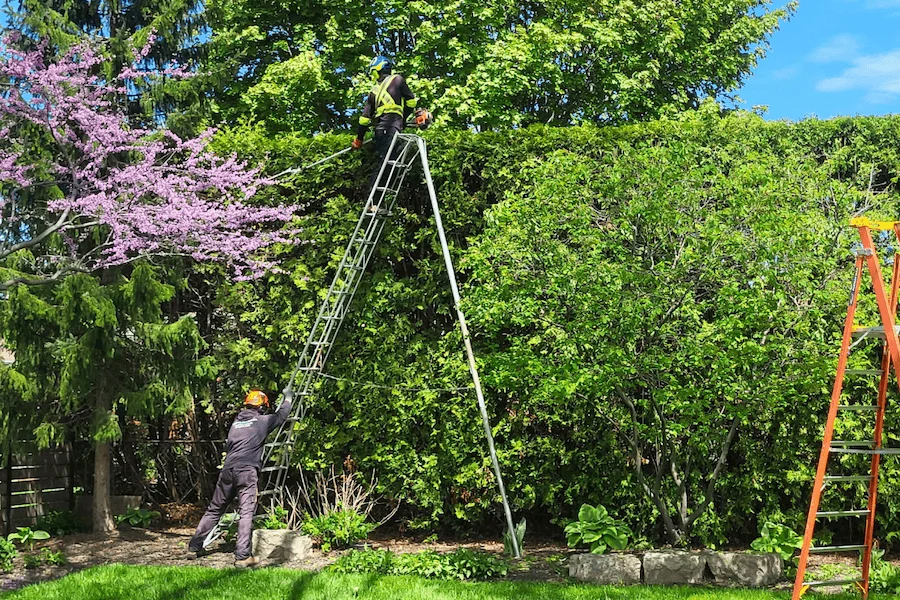
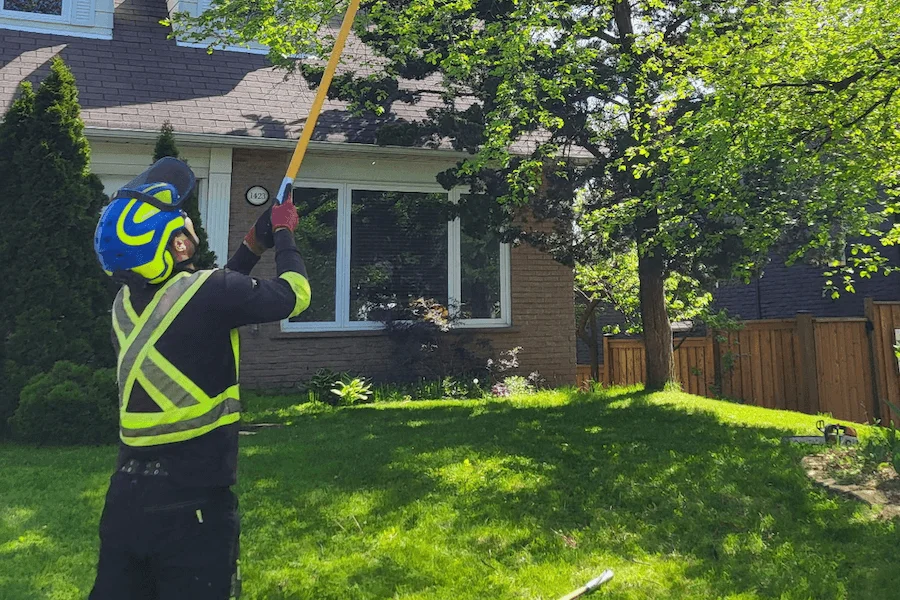
| Do they present themselves professionally with proper safety gear, including hard hats, PPE, and work boots? | If they do not care about their own safety, will they respect your property or tree? |
When a quote isn't enough: arborist reports
Some jobs need paper. Removing a protected tree, building near one, a boundary dispute with a neighbour - the city will ask for an arborist report: a formal assessment of species, size, condition, and a professional recommendation, signed by someone qualified to sign it. Laneway suite applications trip over this constantly; if there's a protected tree within reach of the build, the report is part of the application, full stop. Here's what goes into one.
What it costs
We keep a separate, regularly updated breakdown of what hiring an arborist actually costs in the GTA - by job type, tree size, and access. Short version: most pruning jobs land in the hundreds to low thousands, removals range wider, and a consult with a certified arborist is cheap insurance on a tree that took sixty years to grow.
One honest caveat: the certified quote is sometimes the higher quote. The gap is insurance, training, and equipment - the cost of doing it so you never think about it again. The cheap quote doesn't delete that cost. It defers it to your tree, with interest.
FAQ
How do I verify an arborist's certification? Ask for their name or ISA certification number and check it at treesaregood.org under "Verify a Credential." Free and public. Anyone legitimately certified expects this.
What's the difference between an arborist and a tree removal company? A removal company cuts trees down. An arborist is trained in tree biology - pruning, diagnosis, preservation, risk assessment - and removes a tree when that's actually the right call. When the only tool is removal, every tree looks like a hazard.
Do I need a permit to remove a tree in Toronto? If the trunk is 30 cm across or more at chest height, yes - including on your own property. Nobody can eyeball diameter, so do this instead: wrap a tape measure (or a string) around the trunk about 1.4 m up. If it's 94 cm around or more, the tree is protected. Injuring a protected tree carries the same penalties as removing it.
The Toronto Private Tree Bylaw is up for revision in 2027.
Do I need a certified arborist report for a laneway suite? If there are protected trees on or near the property, Toronto requires one as part of the application, prepared by a qualified arborist.
What if their insurance doesn't check out after the damage is done? Then the claim goes looking for other money - often your homeowner's policy, sometimes you directly. That's why the proof comes before the work, not after.
Why we wrote this We're Tree Doctors - ISA and ASCA certified arborists working across Toronto and the GTA, WSIB covered, with $5 million in liability insurance and over 280 Google reviews. We encourage homeowners to use this checklist when comparing any tree service-including ours.